Why Does Blood Flow Matter?
You’ve probably heard this before:
“Massage increases blood flow, so it helps you heal faster.”
Sounds logical.
More blood = more oxygen and nutrients = faster healing.
Easy. Unfortunately, the human body rarely gives us answers that simple.
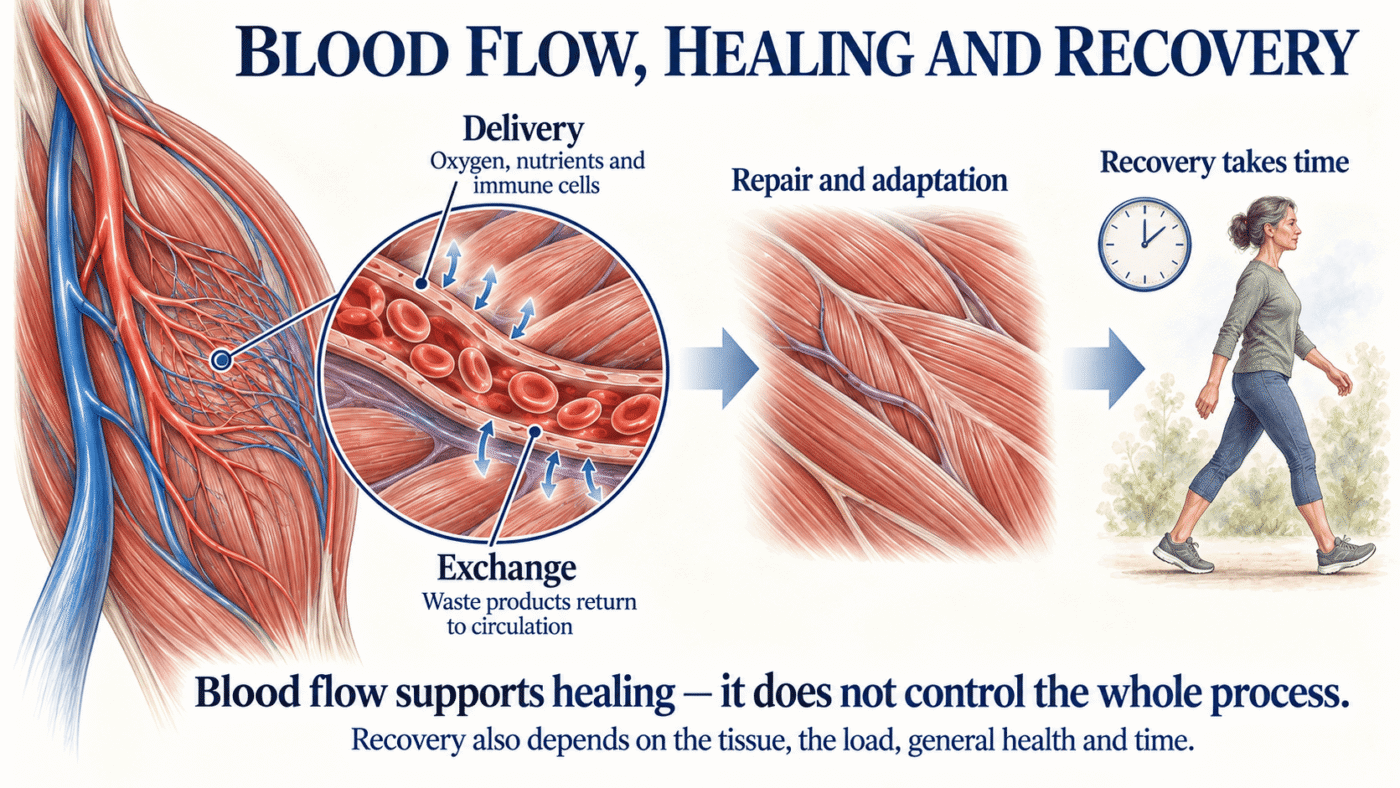
Blood is constantly delivering oxygen and nutrients to tissues while carrying away metabolic waste products.
Without an adequate blood supply, tissues cannot function or repair themselves normally.
So yes — circulation matters.
Stand up and walk around.
But your body is already very good at controlling where blood goes.
Exercise.
Get warm.
Your circulation changes automatically depending on what your body needs. Massage can also produce local changes in circulation, particularly in the tissues being worked on.
But that doesn’t mean:
More blood flow = faster healing.
Healing involves much more than circulation alone.
Your Body Has Its Own Repair Process
When tissue is injured, your body begins a coordinated biological response.
Cells begin repairing damaged tissue. New tissue develops and gradually remodels.
Then that tissue needs time to adapt to the demands you place on it again.
It’s a process. And unfortunately, we can’t simply massage the fast-forward button.
Massage may help some people feel less sore, reduce discomfort or make movement feel easier during recovery.
That can be useful. If moving becomes more comfortable, it may help someone gradually return to normal activity when appropriate. But massage is only one possible part of recovery.
Sleep, nutrition, appropriate movement, exercise, rehabilitation, workload and — most importantly — time can all matter.
It’s to give the body enough time to respond.
Recovery Isn’t Always a Straight Line
Ever felt much better one day… then wondered what happened the next?
That’s surprisingly normal during recovery. Progress can fluctuate. Instead of judging recovery from one good or bad day, look at the bigger picture.
Can you do more?
Are symptoms becoming easier to manage?
Are the improvements lasting longer?
Those changes may tell us more than simply asking whether something hurts today.
Your body already knows how to heal many things.
Our job isn’t always to force that process.
Sometimes it’s to support it, monitor it and know when it needs more help.
Your Body Talks. Learn to Listen.
What’s the hardest part of recovery for you — pain, patience, resting, or resisting the temptation to test it every five minutes?
Tell us below.

Ask it. Even if you think it’s a ridiculous question.
Someone else has probably wondered exactly the same thing.
