Pain is strange.
“When did that happen?”
A tiny paper cut can be incredibly annoying. You can bump your leg, discover a huge bruise the next day and think:
And sometimes something hurts even when you can’t remember injuring it at all. So what exactly is pain?
Pain Is Your Body’s Protection System
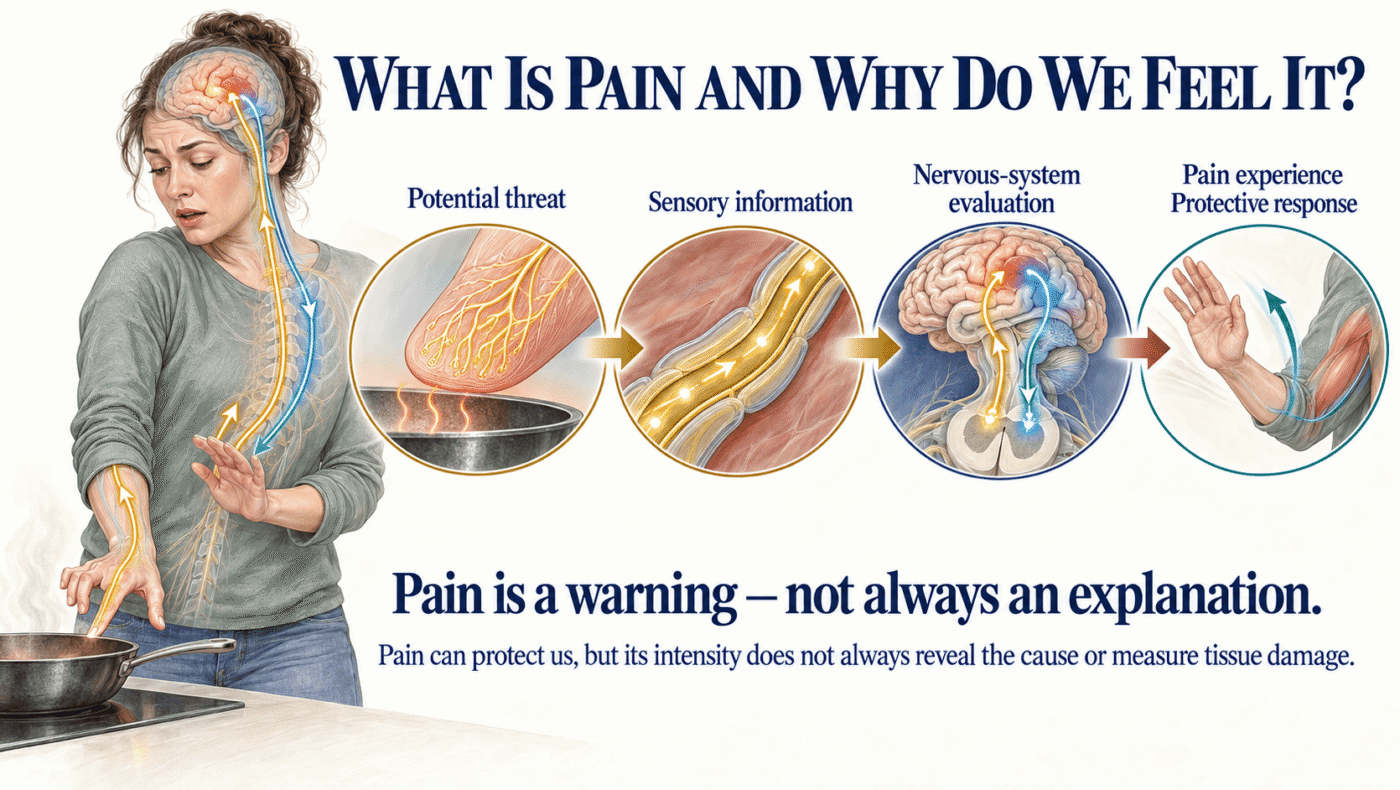
The easiest way to think about pain is as a protective experience.
Your nervous system constantly receives information from your body and the world around you.
Heat. Pressure. Movement. Chemical changes. Potential tissue damage.
When your brain and nervous system interpret the situation as threatening enough, pain may become part of the response.
That pain encourages you to pay attention.
Stop. Move. Protect. Change something.
Very useful when you’ve just stepped on something sharp. But pain isn’t always that simple.
Pain Doesn’t Equal Damage
This is one of the most important things to understand. Pain is real but the amount of pain you feel isn’t a direct measurement of how much tissue damage exists.
When something hurts, it’s understandable to want the pain to disappear as quickly as possible.
Sometimes pain-relieving medication can be useful and appropriate. But reducing pain and understanding why the pain is happening are not always the same thing.
Think of pain like a warning light. Turning down the warning can make you feel better and sometimes that’s exactly what you need.
But if the warning keeps returning, it may be worth asking:
“What is my body trying to tell me?”
For example, if pain appears to involve muscles or movement, we may need to look beyond the painful spot.
Is a particular activity repeatedly aggravating it?
Is there weakness, stiffness or reduced mobility?
Has your workload, exercise or daily routine changed?
In those situations, assessment, appropriate treatment, movement or rehabilitation may form part of addressing the problem rather than focusing only on temporary pain relief.
But there’s another important point:
Sometimes pain needs medical investigation. Sometimes medication is an important part of treatment. Sometimes rehabilitation is needed. And sometimes several approaches work together.
The goal isn’t to choose between medicine or massage. The goal is to understand the problem well enough to choose the right response.
“Where does it hurt?”
We can also ask:
When did it start?
What makes it worse?
What makes it better?
Has your movement changed?
Is anything else happening?
Those questions give pain context. And context helps us decide what to do next.
Pain tells you that something deserves attention. It doesn’t always tell you exactly what the problem is.
That’s why chasing the painful spot — or simply trying to make the sensation disappear isn’t always enough. Before trying to “fix” pain, we should first try to understand it.
Sometimes pain relief is part of the answer.
Sometimes treatment is part of the answer.
And sometimes pain is telling you that it’s time to investigate further.
Pain tells you that something deserves attention. It doesn’t always tell you exactly what the problem is.
That’s why chasing the painful spot isn’t always enough. Before trying to “fix” pain, we should first try to understand it.
Because the better you understand what your body is telling you, the better questions you can start asking. And sometimes, the right question is the beginning of the right treatment.
Your Body Talks. Learn to Listen.
When you feel pain, what’s your first reaction?
Ignore it? Take something? Stretch it? Massage it? Or wait three months and hope it magically disappears?
Be honest. We’ve all tried the last one.

Ask it. Even if you think it’s a ridiculous question.
Someone else has probably wondered exactly the same thing.
