
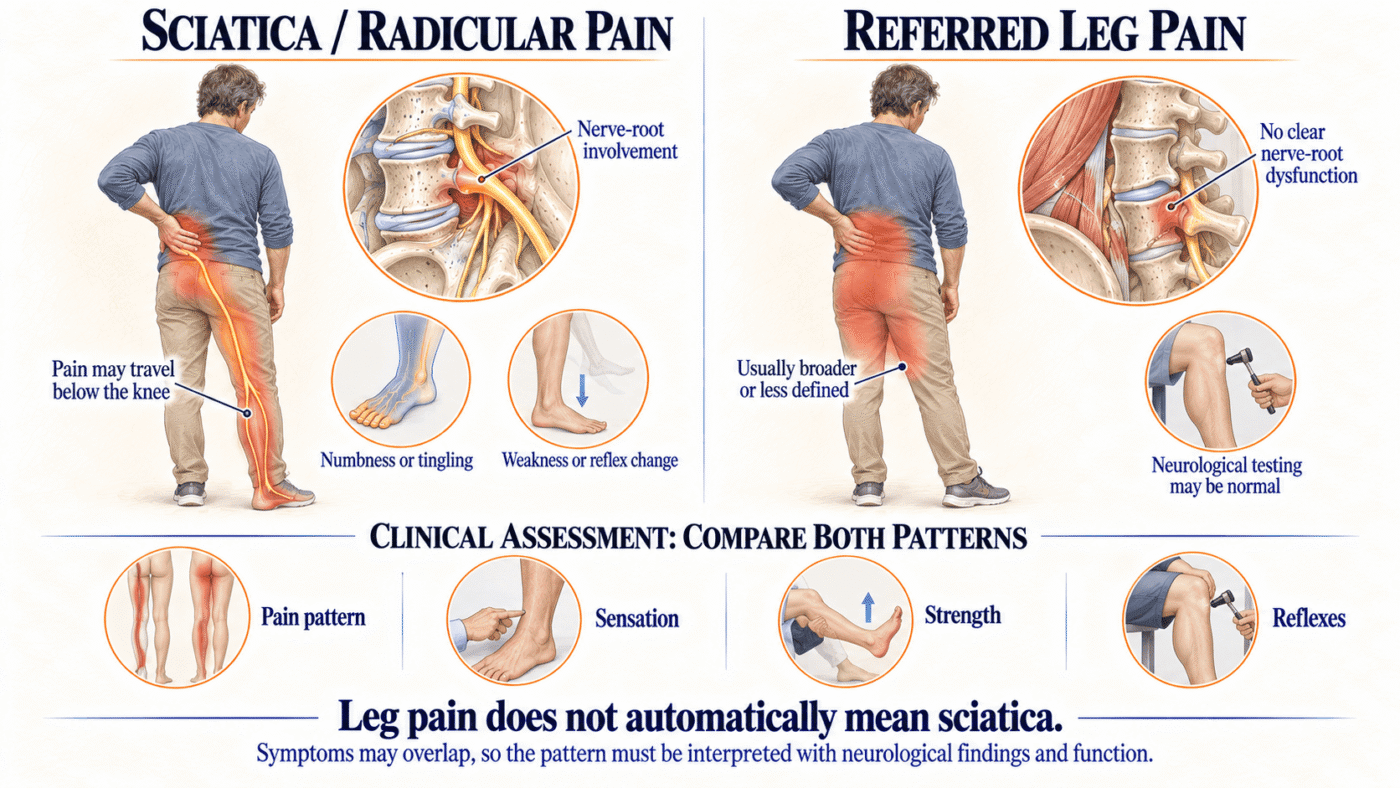
“My back hurts and the pain goes down my leg.”
“It must be sciatica.”
Maybe.
But pain travelling into the buttock or leg doesn’t automatically mean the sciatic nerve is the problem. This is where sciatica and referred pain often get mixed up.
They can feel similar. But they’re not necessarily the same thing.
The sciatic nerve is a large nerve formed from nerve roots in the lower spine and travelling through the buttock into the leg.
Sciatica describes symptoms associated with irritation or compression affecting the nerve roots that contribute to the sciatic nerve. Pain may travel from the lower back or buttock into the leg. But pain isn’t the only thing we pay attention to.
Some people may also experience:
- tingling
- numbness
- burning or electric-like sensations
- weakness
- changes in sensation
The exact pattern can vary. So simply having pain in the back of your leg isn’t enough to confidently say: “That’s sciatica.”
“The pain goes from my back into my leg.”
But they may not have the same problem. Same location.
Different story.
Here’s where it gets interesting. Pain can be felt in one area even though the source of the problem may be somewhere else. This is called referred pain.
Structures around the lower back, joints and surrounding tissues can sometimes produce pain that is experienced in the buttock, thigh or leg without the sciatic nerve necessarily being the primary problem.
This is where we need to be careful. You may hear: “Your piriformis is tight and trapping your sciatic nerve.”
That can sound like a wonderfully simple explanation. Unfortunately, bodies don’t always cooperate with wonderfully simple explanations.
Muscles around the hip and buttock may certainly be painful or relevant to someone’s symptoms. But we shouldn’t assume that every pain travelling down the leg is caused by a tight muscle pressing on the sciatic nerve.
Before deciding what needs treatment, we need to understand the presentation.
Instead of asking only: “Where is the pain?” ask what else is happening.
Does the pain travel below the knee?
Is there numbness or tingling?
Has strength changed?
Do certain spinal movements change the symptoms?
Is walking different?
Are the symptoms improving, staying the same or getting worse?
This is where assessment becomes much more useful than simply pressing the painful area. Pain location gives us a clue. It doesn’t give us the diagnosis.
Massage may help some people manage muscle tension, discomfort or movement around the lower back and hip region. But if symptoms appear neurological, simply massaging harder along the painful pathway isn’t necessarily appropriate.
And a nerve isn’t something we need to “massage the pain out of.” Depending on the presentation, management may involve movement, exercise, rehabilitation, medical assessment or other healthcare. Sometimes massage may form part of that plan. Sometimes it shouldn’t be the first step.
New or worsening weakness, significant numbness, or progressive neurological changes deserve medical assessment.
And if back or leg pain is accompanied by new bladder or bowel dysfunction, numbness around the groin, genitals or inner-thigh area, or significant weakness affecting the legs, seek urgent medical assessment. These symptoms are uncommon. But they’re important to recognise.
The goal isn’t to make every shooting pain frightening. It’s to know when something needs more investigation than: “Let’s see if this muscle is tight.” So the next time someone says: “I’ve got sciatica.”
The useful question might be: “What symptoms are you actually experiencing?” Because pain travelling down the leg tells us where you feel it. It doesn’t automatically tell us why it’s there.
Your Body Talks. Learn to Listen.
Quick question:
Have you ever called your leg pain “sciatica” because someone told you that’s what it was?
No judgement.
Sciatica may be one of the most self-diagnosed conditions on the internet.

Ask it. Even if you think it’s a ridiculous question.
Someone else has probably wondered exactly the same thing.
