there’s a problem.
“Where does it hurt?”
“Right here.”
“Okay, lie down.”
That’s certainly one way to start treatment.
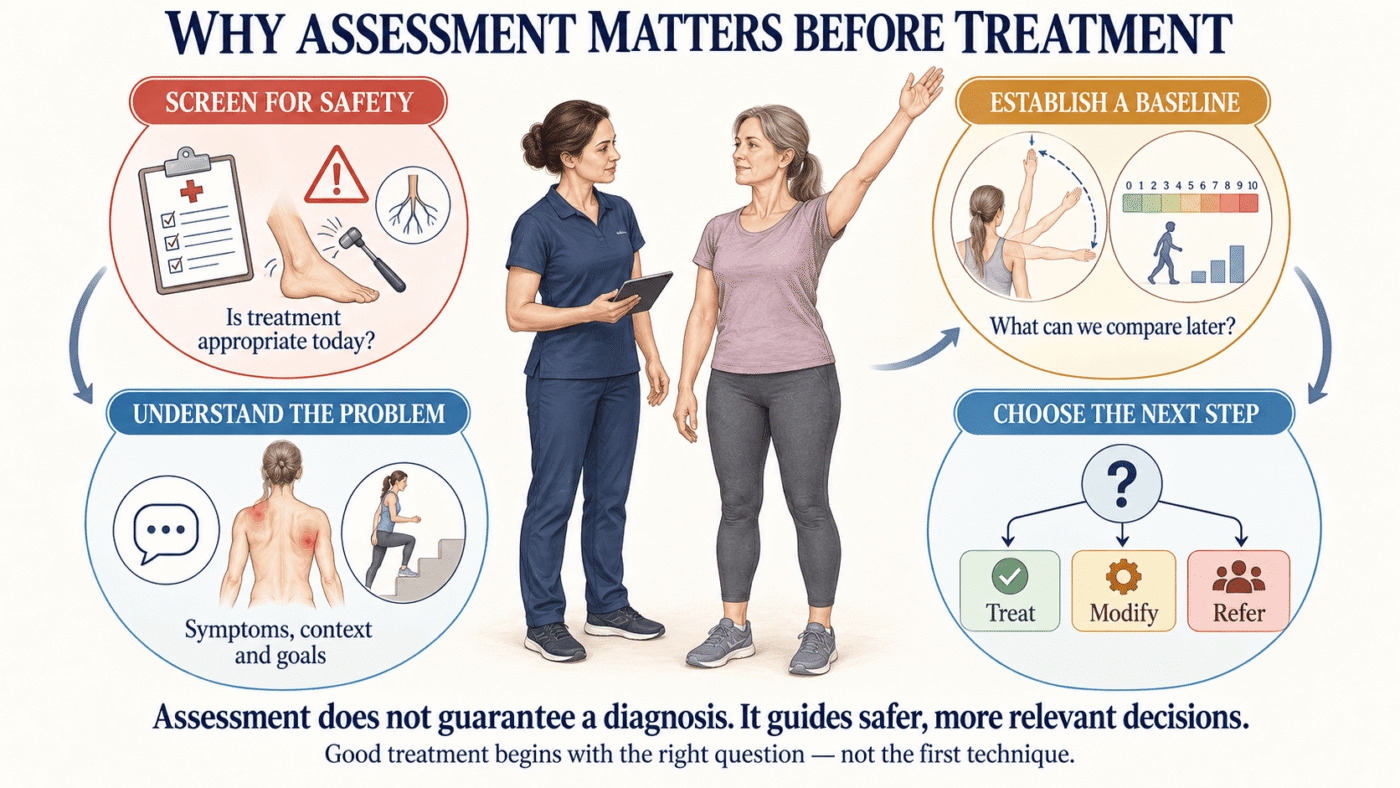
Where you feel pain doesn’t always tell us why it hurts.
And if we don’t understand the problem we’re trying to change, how do we know what to treat? That’s where assessment begins.
Assessment Starts With a Conversation
Assessment doesn’t necessarily mean complicated machines, scans or twenty different tests.
Often, it starts with listening.
When did the problem begin?
Was there an injury?
What makes it worse?
What makes it better?
Has it changed the way you work, sleep, exercise or move?
Are there numbness, tingling, weakness or other symptoms?
Sometimes one answer completely changes what should happen next.
“Which muscle should I massage?”
we should first ask:
“Is massage appropriate for this problem?”
The Painful Spot Isn’t Always the Whole Story
Imagine your shoulder hurts when you raise your arm.
We could immediately massage the shoulder.
But first, what happens when you actually raise it?
How far can you move?
Where does discomfort begin?
Is the movement weak, painful, restricted — or simply different?
Does your shoulder blade move comfortably?
Are there symptoms travelling into the arm?
Suddenly we have much more useful information than:
“My shoulder hurts here.”
The painful area still matters.
It just isn’t the entire assessment.
This is one of the most useful parts.
Before treatment:
“Turn your head to the right.”
After treatment:
“Try it again.”
Did the movement improve?
Did the pain change?
Does it feel easier?
Nothing changed?
That’s useful information too.
Without assessing first, it’s very easy to finish a treatment and ask:
“How do you feel?”
“Good.”
Excellent.
Assessment gives us a starting point.
Reassessment tells us whether we’re moving in the right direction.
Sometimes Assessment Tells Us Not to Treat
This may be the most important part.
Assessment isn’t only about choosing a massage technique.
Sometimes it identifies something that doesn’t fit an ordinary musculoskeletal presentation.
Significant weakness.
Unusual neurological symptoms.
Unexplained swelling.
A concerning injury.
Symptoms that need medical investigation.
In those situations, the best clinical decision may be:
“Let’s get this checked before we treat it.”
Knowing when not to massage is just as important as knowing how to massage.
Remedial treatment shouldn’t become a collection of techniques performed simply because an area feels tight.
Deep tissue.
Trigger points.
Stretching.
Cupping.
More pressure.
More techniques don’t automatically mean better treatment.
A simpler process makes much more sense:
Listen → Assess → Treat → Reassess → Decide what comes next
Maybe treatment helped.
Maybe something needs to change.
Maybe exercise or rehabilitation should become part of the plan.
Maybe we need more information.
Or maybe massage isn’t the right tool for this problem.
That’s clinical reasoning.
Assessment doesn’t need to make treatment complicated.
It makes treatment purposeful.
“What technique are you going to use?”
there may be a better question:
“What are we trying to change?”
If we can answer that, we finally have something meaningful to treat — and something meaningful to measure.
Your Body Talks. Learn to Listen.
Here’s a question for you:
Before your last treatment, did anyone actually check your movement first?
And more importantly…
did they check it again afterwards?
Ask it. Even if you think it’s a ridiculous question.
Someone else has probably wondered exactly the same thing.
