Which techniques are you using today?
But here’s the problem:
A little deep tissue massage?
Some trigger point therapy?
Myofascial release?
Joint mobilisation?
Stretching?
Cupping?
Maybe all of them?
It sounds impressive. Using more techniques doesn’t automatically create a better treatment.
A treatment plan isn’t a collection of everything a therapist knows how to do.
It’s a series of decisions.
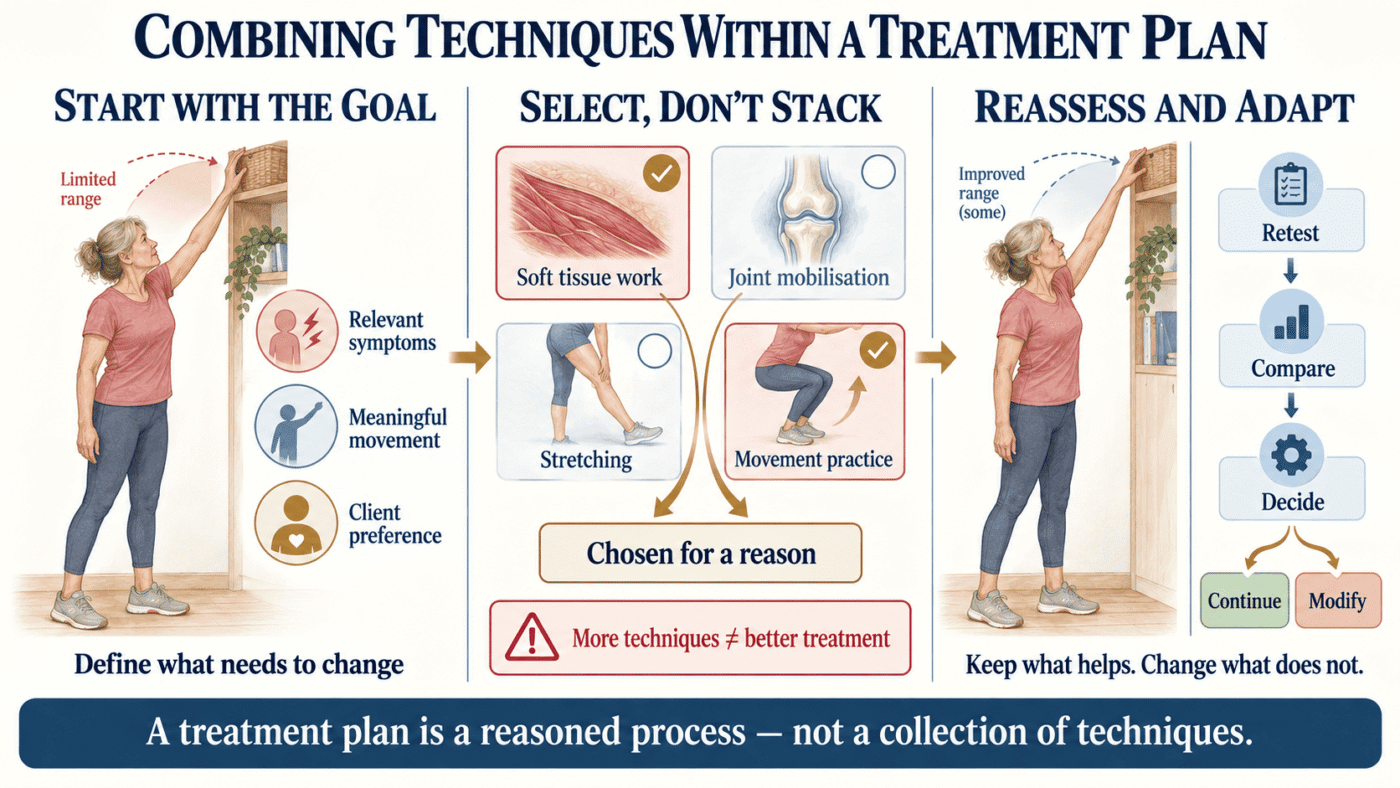
Start With the Problem Not the Technique. Imagine two people both arrive with shoulder pain. One has difficulty reaching overhead after increasing their training.
The other has pain when sleeping on the shoulder and noticeable weakness when lifting the arm. Same body area. Same word: shoulder pain. But potentially very different presentations.
Giving both people exactly the same sequence of massage, trigger point therapy, cupping and stretching simply because that’s the therapist’s usual routine misses the point of assessment.
What are we actually trying to change?
Pain? Range of motion? A particular movement? Comfort during work? Ability to train? Sleep? Function?
Once we know the target, techniques can be selected for a reason.
Different Techniques Can Have Different Roles
For example, a treatment might include manual massage techniques to work with a sensitive area, joint mobilisation to explore whether movement becomes easier, stretching or assisted movement to work through a comfortable range, or cupping as another form of sensory and mechanical input.
There doesn’t have to be one “correct” technique. And techniques don’t necessarily need to compete with each other. The question is whether each one contributes something useful to the treatment plan.
Every technique should earn its place.
This is where treatment can become unnecessarily complicated. Ten minutes of this. Five minutes of that. Three cups here. Stretch this. Mobilise that.
Find six trigger points. Finish with something else because we still have eight minutes left. At the end, everyone is very busy. But what did we actually learn?
If too many things are changed at once, it may even become difficult to understand what influenced the outcome. Sometimes a simpler treatment plan gives us clearer information.
Treatment Can Be a Series of Small Experiments A useful way to think about treatment is:
Assess → Choose → Treat → Reassess → Adapt
Suppose turning your neck to the right is uncomfortable. That’s our starting point. We apply one appropriate intervention. Then: Turn right again. Better? Worse? No different?
That response gives us information. Perhaps we continue. Perhaps we modify the technique. Perhaps we try another approach. Or perhaps the result makes us reconsider what we thought was important.
Treatment doesn’t always need to follow a script. It can evolve from the information the body gives us.
There’s another important point. Suppose we use massage, trigger point therapy, mobilisation and stretching during one session. At the end, movement improves.
Excellent. But can we confidently say: “The trigger point therapy fixed it”? Probably not. Several interventions were used, symptoms can fluctuate, and movement may change for multiple reasons. We can observe the outcome without inventing certainty about the mechanism.
Something changed.
Now we determine whether that change is meaningful and whether it lasts. That’s more useful than creating a perfect story after the fact.
Pressure and Intensity Should Also Have a Reason
Combining techniques shouldn’t mean accumulating intensity. Deep tissue massage followed by aggressive trigger point work followed by strong cupping followed by forceful stretching doesn’t automatically create a “complete” remedial treatment.
Sometimes tissues are already sensitive. Sometimes less is enough. Sometimes a gentler approach allows someone to move more comfortably. The client should also be involved in these decisions.
What Happens After Manual Therapy Matters
Imagine treatment reduces someone’s shoulder discomfort and they can suddenly reach overhead more comfortably. Great. Now we have an opportunity.
Perhaps they practise the movement. Perhaps rehabilitation or strengthening becomes relevant. Perhaps workload needs to be adjusted. Perhaps we simply observe how the improvement behaves over the following days.
Manual therapy may help create a window where movement feels easier. The treatment plan should consider what happens inside that window. Otherwise, we may repeatedly create temporary change without asking how it contributes to longer-term function.
Sometimes the Best Combination Includes Less Massage
This might sound strange coming from a massage therapist. But a good treatment plan doesn’t have to consist entirely of massage. Depending on the problem, it may involve:
Manual therapy + movement
Massage + exercise
Mobilisation + rehabilitation
Treatment + workload modification
or sometimes:
No massage yet + appropriate medical assessment
The goal isn’t to prove how many techniques we can perform. The goal is to choose what makes sense for the person in front of us.
Reassessment Holds Everything Together
Without reassessment, combining techniques can easily become routine. With reassessment, each technique becomes part of a clinical decision-making process.
Your Body Talks. Learn to Listen.
And if your treatment requires so many techniques that nobody can remember why they started… we may have lost the plot somewhere around cup number seven.
Ask it. Even if you think it’s a ridiculous question.
Someone else has probably wondered exactly the same thing.
