I need more mobility.
So you stretch.
And stretch.
And stretch a little more.
Your range improves.
But somehow, the movement still doesn’t feel strong, comfortable or controlled.
What’s missing? Sometimes the answer isn’t more flexibility. It may be strength.
Mobility Is More Than Being Flexible
In our previous discussion, we separated two ideas:
Flexibility = How much range is available.
Mobility = How well you can actively use the range you need.
That second part is important. Because reaching a position passively and controlling your body in that position are not the same thing. You may have enough flexibility. But do you have the strength to use it?
Available Range vs Usable Range
Imagine lying down while someone lifts your leg. It moves quite far. Now stand up and lift the same leg yourself.
Suddenly, the range is much smaller.
Where did your flexibility go?
Nowhere. The difference is that one movement was assisted. The other required you to actively produce and control the movement.
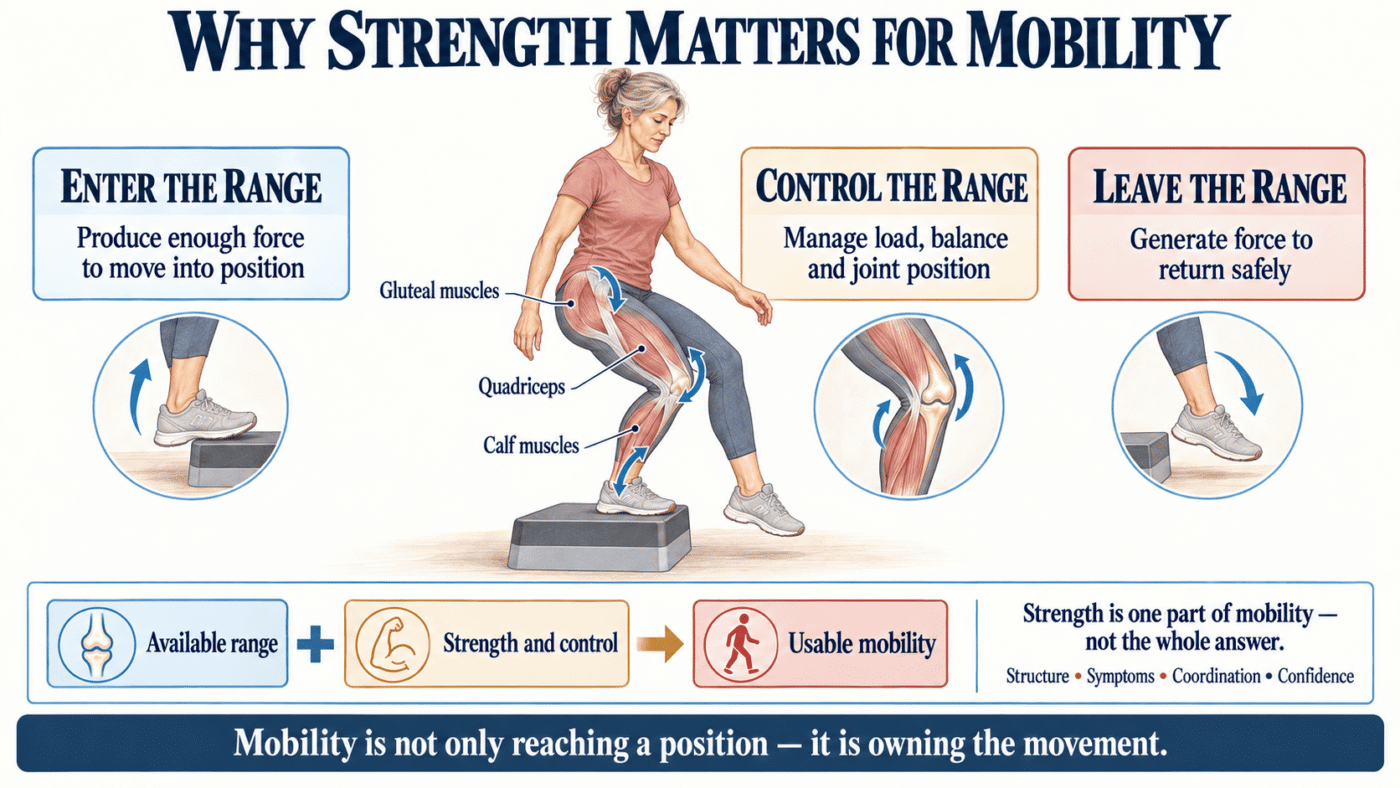
Available range isn’t always usable range. Strength can help turn available movement into movement you can actually control.
Strength Isn’t Just About Lifting Heavy Weights. When people hear the word strength, they often picture: Heavy barbells. Big muscles.
Someone making a very concerning facial expression at the gym. But strength simply refers to the ability to produce force. For mobility, that force may need to be produced through different parts of your available range.
Consider reaching overhead. You need enough movement at the shoulder and surrounding regions. But you also need muscles to move the arm, control the shoulder and manage the position.
Having more passive range without being able to control it doesn’t necessarily improve the task.
Sometimes “Tightness” Isn’t Asking for Another Stretch
Suppose your hip constantly feels tight.
“I need to stretch my hip.”
Maybe. But what happens if you’ve been stretching it every day for months and it still feels tight? That’s worth investigating.
The sensation of tightness doesn’t automatically prove that a muscle is physically too short. Perhaps workload matters. Perhaps the area is sensitive. Perhaps movement habits have changed. Perhaps strength or control deserves attention.
Or perhaps something else entirely is contributing. Instead of endlessly stretching the sensation, ask: “What does this area struggle to do?” That question can lead somewhere much more useful.
Mobility isn’t simply reaching the end of a movement. We also need to control what happens on the way there — and sometimes what happens when we arrive.
Think about a squat. Having enough movement at the hips, knees and ankles matters. But so does having enough strength and control to lower yourself, manage the position and stand back up.
Getting down is only half the adventure. Eventually, you have to come back. This is why mobility and strength shouldn’t always be treated as separate worlds.
They often work together. More Strength Isn’t Automatically Better Either There’s an important balance here. We shouldn’t replace: “Everyone needs more flexibility.” with: “Everyone needs more strength.” That’s the same mistake wearing gym clothes.
Strength should relate to the person’s needs.
A runner.
A gardener.
A massage therapist.
An older adult wanting to get comfortably out of a chair. Someone returning to sport after injury. They don’t necessarily need the same strength or mobility.
Range → Control → Function
This gives us a simple framework:
Range → Control → Function
Range: Is enough movement available?
Control: Can you actively manage that movement?
Function: Can you use it for the activity that matters?
Sometimes flexibility is the limiting factor. Sometimes strength. Sometimes pain. Sometimes coordination, confidence, workload or another health issue matters. And sometimes several factors are involved. That’s why good movement assessment shouldn’t begin with: “Which muscle should we stretch?” or: “Which muscle should we strengthen?” It should begin with: “What are you trying to do?”
Then we work backwards. Mobility isn’t about collecting as much range as possible. And strength isn’t about becoming as powerful as possible. The goal is to have enough movement, strength and control for the life you want your body to perform.
Your Body Talks. Learn to Listen.
And if you can get into an impressive stretch but can’t comfortably get yourself back out… we may have discovered what to work on next.
Ask it. Even if you think it’s a ridiculous question.
Someone else has probably wondered exactly the same thing.
