
What is the perfect sitting position?
“Sit up straight.”
“Shoulders back.”
“Don’t slouch.”
“Keep your screen exactly here.”
And somehow, after following all that advice, your neck still feels stiff at 4:00 pm.
So what’s going wrong?
Maybe the problem isn’t that you haven’t found the perfect posture.
Maybe you’ve simply been in one position for too long.
Sitting Isn’t Automatically Bad for You.
Let’s start here. Sitting is a normal human activity. Your spine doesn’t begin deteriorating the moment you sit at a desk. And slouching occasionally doesn’t mean you’ve damaged your posture.
The bigger issue is often how much variety your body experiences throughout the day. If you sit in essentially the same position for hours, you may begin to feel stiff, tired or uncomfortable.
Interestingly, even a theoretically “perfect” posture can become uncomfortable if you hold it long enough.
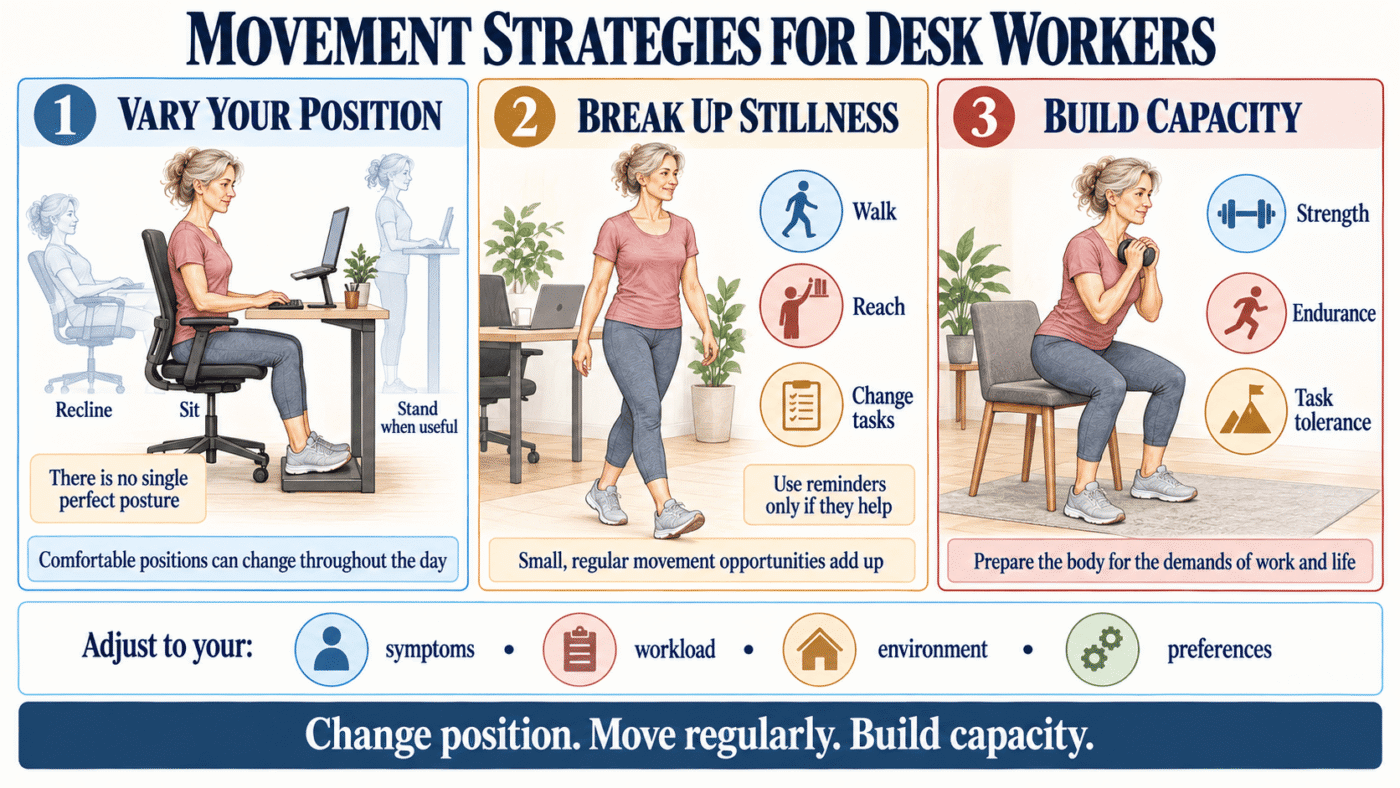
Your Best Posture May Be Your Next Posture
You don’t need to sit upright like someone is taking your passport photo for eight hours. Sit upright sometimes. Lean back sometimes. Change your leg position.
Stand.
Walk.
Move your shoulders.
Turn your head.
Then sit again.
The goal isn’t constant correction. It’s movement variety. A useful principle is: Change positions. Move regularly. Give your body options.
You don’t necessarily need a 20-minute mobility routine every hour. Small amounts of movement throughout the day can be easier to maintain. Think of them as movement snacks. Stand while taking a phone call.
Walk to get water.
Take the stairs.
Move your shoulders through a comfortable range.
Turn your neck gently.
Walk around between tasks.
Stand up while reading something.
None of this looks particularly impressive on Instagram. That’s fine. Your body doesn’t know whether your movement routine has good lighting.
One of the hardest parts of movement advice is remembering to do it. Instead of relying entirely on motivation, connect movement with things that already happen. For example:
Finished a meeting?
Stand and walk briefly.
Making coffee?
Move while you wait.
Going to the bathroom?
Take the slightly longer route back.
Finished a major task?
Change position before starting the next one. This turns movement into part of your workday rather than another job on your to-do list.
Desk workers often report tight: Necks, Shoulders, Hip flexors, Lower backs, Hamstrings. The obvious response is: Stretch everything.
But remember: Feeling tight doesn’t automatically mean a muscle is physically too short.
If stretching feels useful, it may absolutely have a place. But if you’ve stretched the same area every day for six months and it still feels exactly the same, perhaps it’s time to ask a different question.
What movement is missing?
Is the area tired?
Does strength matter?
Has workload increased?
Does the workstation contribute?
Is stress influencing how the area feels?
Or is there another problem that deserves assessment?
Don’t just chase tightness. Investigate the pattern.
Moving more during work is useful. But don’t forget what happens outside work. Walking.
Resistance exercise.
Sport.
Swimming.
Cycling.
Gardening.
Mobility work.
Anything that gives your body different physical demands can contribute to your overall capacity. This matters because the goal isn’t simply to become better at sitting. The goal is to have a body capable of doing more than sitting.
If your entire strategy for eight hours of desk work is one neck stretch at lunchtime, we may be slightly underprepared.
Ergonomics can still matter. Screen position, chair setup, keyboard and mouse placement, desk height and the way your work is organised may influence comfort. But ergonomics shouldn’t become a search for one mathematically perfect position.
A beautifully adjusted chair doesn’t eliminate the need to move. And an imperfect posture isn’t automatically harmful. Think of workstation setup as one part of the strategy:
Make comfortable positions easier and make changing positions possible.
Suppose your neck begins hurting every afternoon. That’s useful information. Ask:
When does it begin?
What were you doing beforehand?
Does standing change it?
Does walking help?
Does moving your neck help?
Does it happen on weekends?
Has your workload changed?
Does it affect sleep?
Are there other symptoms?
Instead of simply saying: “My posture is bad.” we now have information we can actually investigate. Where Does Massage Fit?
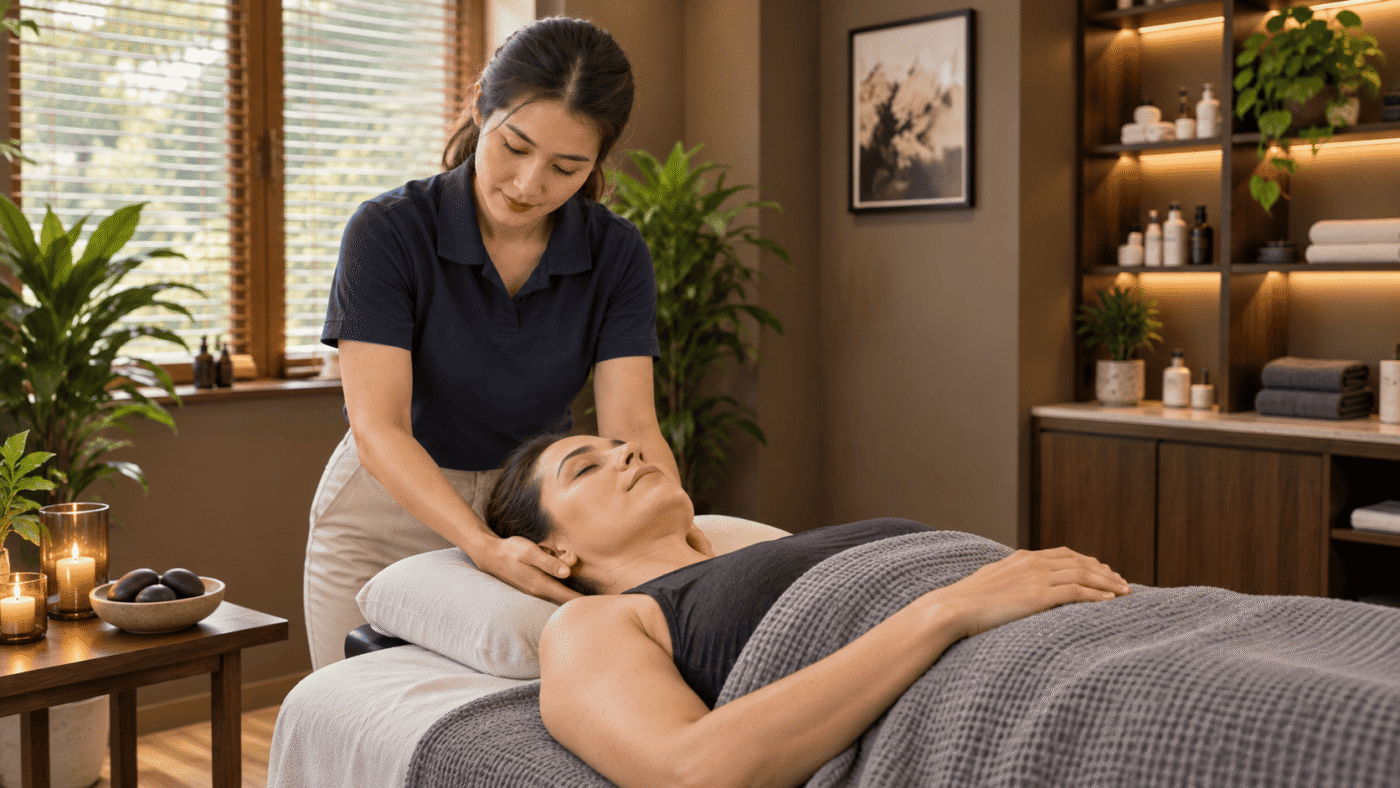
Massage may help some desk workers with pain, discomfort, muscle tension or movement. But massage shouldn’t become the weekly reset button that allows the same problem to continue indefinitely without investigation.
If treatment helps your neck move more comfortably, excellent. Now ask: What happens when you return to the desk?
Can we maintain useful movement?
Does strength need attention?
Can work habits change?
Can movement be distributed differently throughout the day?
And if the same problem repeatedly returns despite treatment, perhaps we need to reassess what we’re trying to change.
Temporary relief can be valuable. But temporary relief and solving a recurring problem aren’t necessarily the same thing.
You Don’t Need a Perfect Routine
This is probably the most practical advice in the entire article. You don’t need:
A complicated mobility program.
Twelve corrective exercises.
A perfect chair.
Perfect posture.
Or an alarm screaming MOVE! every seventeen minutes. Start with something realistic.
Sit → Change position → Move → Return to work
Then repeat naturally throughout the day. Add regular physical activity outside work when appropriate. Build strength and capacity gradually. And pay attention to what actually makes a difference.
Because the best movement strategy isn’t the one that looks perfect on paper. It’s the one you can consistently fit into your real life. So tomorrow at work, don’t spend eight hours worrying about whether you’re sitting correctly.
Every now and then, simply ask: “Have I changed position recently?” If the answer is no… there’s your cue.
Your Body Talks. Learn to Listen.
And yes, walking to the kitchen for coffee technically involves movement.
We’re just not going to pretend the fourth coffee was prescribed as rehabilitation.
Ask it. Even if you think it’s a ridiculous question.
Someone else has probably wondered exactly the same thing.
