
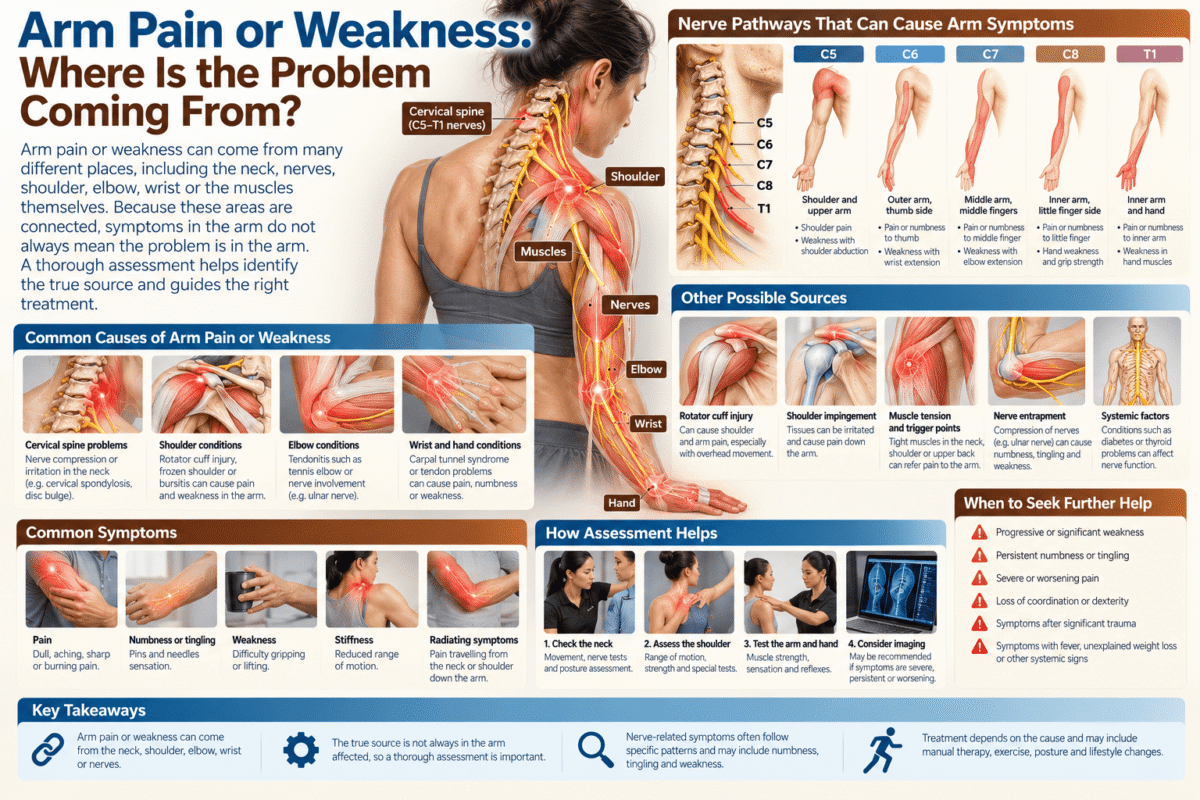
Arm Pain or Weakness
Where Is the Problem Coming From?
Is the problem in your hand? Your arm? Perhaps your shoulder?
The honest answer is that the place where you notice a symptom does not always tell you where it began.
“You can lift your arm. But halfway through carrying a bag, your hand starts to lose its grip.”
Your arm depends on joints and muscles to move, while nerves carry signals between your neck and hand. Shoulder problems can send pain down the arm; nerve problems may cause tingling, numbness or weakness. The pattern of symptoms helps decide what to assess next.
What are you actually feeling?
Start with the change you can describe:
- Pain: Where is it strongest? Does lifting, gripping or turning your neck change it?
- Tingling or numbness: Does it travel down the arm or reach particular fingers?
- Reduced strength: Are you dropping objects, struggling to lift, or stopping because the movement hurts?
- Stiffness: Which movement feels limited, and does it change as you move?
These details are clues, not a way to diagnose yourself. For example, symptoms in the fingers can matter during an assessment, but one numb finger does not prove that a particular spinal nerve is responsible.
Why would someone check my neck if my arm hurts?
Because a nerve problem in the neck can affect how an arm feels or moves. Equally, pain around the shoulder can extend into the arm. Problems closer to the elbow, wrist or hand may produce their own symptoms. An assessment looks at the pattern rather than assuming every arm symptom has the same source.
Tell the clinician whether your symptoms began after an injury, appeared gradually, or change when you move your neck, shoulder, elbow or wrist. Also mention if the arm feels different on one side.
What happens during an assessment?
A clinician may watch you perform the task that has become difficult: reaching overhead, carrying a bag or gripping a cup. They may check movement and strength, then assess sensation or reflexes when nerve symptoms are present.
The aim is to answer a practical question: What needs attention so you can use your arm more comfortably and safely? Depending on the findings, care may involve activity changes, guided exercise, physiotherapy or medical assessment.
Can massage help arm symptoms?
Massage may help some people with accompanying neck or shoulder discomfort. However, relief after a session does not establish the cause of arm pain, and massage cannot replace an assessment of persistent numbness or increasing weakness. Research suggests any benefit for neck or shoulder pain may be short term.
Before treatment, tell your therapist if you are dropping things, losing sensation or finding that the arm is becoming weaker. Those details should influence the decision to treat or refer.
When should you seek urgent help?
Call your local emergency number if arm weakness or numbness appears suddenly, especially with facial drooping or difficulty speaking even if the symptoms improve. These may be signs of a stroke or transient ischaemic attack.
Arm pain together with chest pressure, shortness of breath, sweating or nausea also needs emergency assessment. After an injury, seek prompt care if the arm looks deformed or you cannot use it.
From a therapist: “Show me what your arm can no longer do comfortably. That tells me more than pointing to one painful spot.”
Your Body Talks. Learn to Listen.
“Arm symptoms” are a starting point, not a diagnosis. Notice whether the main change is pain, sensation or strength, and describe the task that brings it on. That gives you and your clinician a better route towards appropriate care.

Ask it. Even if you think it’s a ridiculous question.
Someone else has probably wondered exactly the same thing.
