
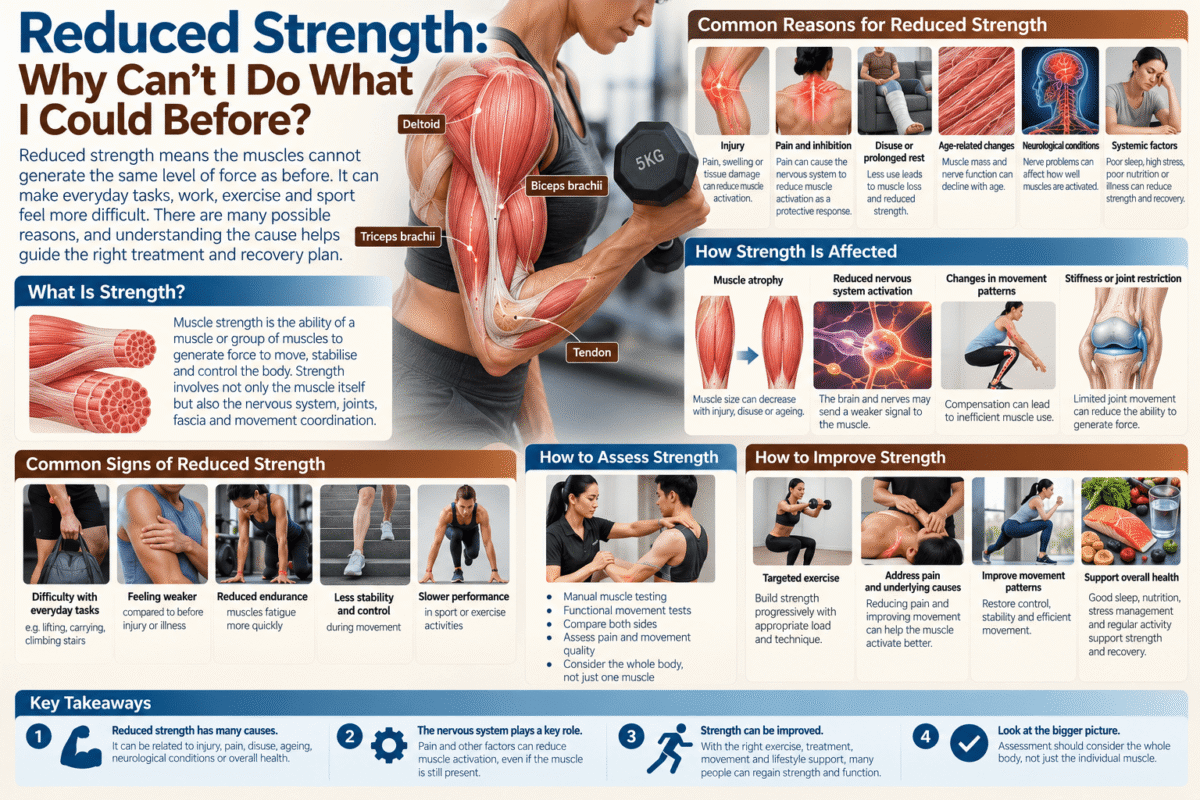
Reduced Strength
Why Can’t I Do What I Could Before?
You might call that weakness, but the word describes several different experiences. Perhaps the arm hurts when you lift. Maybe you feel exhausted throughout your body.
“I used to carry this bag easily. Now my arm gives up halfway.”
Or you may be trying just as hard as before, yet the arm cannot produce the same force. The first question is not how to make the muscle stronger. It is what has changed and when.
Is it weakness, pain or fatigue?
These experiences can overlap. A painful shoulder may stop you from lifting even though the muscle can still produce force. After demanding activity, a muscle may tire sooner than expected. In other cases, a clinician may find a measurable loss of strength during an examination.
To help explain the difference, describe a task rather than saying only “I feel weak”:
- “I cannot raise my right arm as high as before.”
- “My grip gives way and I drop objects.”
- “Both legs feel tired after walking.”
- “I can lift the weight, but pain stops me.”
Clinicians use the timing, location and associated symptoms to help distinguish fatigue or pain from reduced muscle strength.
What could cause reduced strength?
The answer depends on your history and examination. Reduced strength may follow an injury or time away from activity. It can also be associated with problems involving muscles or the nerves that control them. Therefore, feeling weaker does not identify one particular muscle or spinal nerve on its own.
Notice whether the change affects one side or both, appeared suddenly or gradually, and comes with pain, numbness or tingling. If you have recently started a medication and developed muscle pain or weakness, discuss the change with your doctor or pharmacist.
How is strength assessed?
A clinician may ask you to perform a familiar movement, then compare sides and check how much force you can produce. Depending on your symptoms, they may also assess sensation, reflexes and coordination. The purpose is to work out whether the problem appears related to pain, a local injury, loss of conditioning or something that needs medical investigation.
A useful goal is specific: “Can I climb the stairs safely?” tells you more about progress than “Do I feel stronger today?”
What are the treatment options?
Treatment follows the cause. A suitable plan might involve gradually rebuilding activity and strength, managing pain, or rehabilitation guided by a physiotherapist. Suspected nerve or medical causes need assessment and may require different care.
If your strength continues to decline, arrange a medical review instead of repeatedly testing the limb or trying to train through the problem.
Can massage help?
Massage may help with accompanying discomfort or relaxation for some people. It cannot establish the cause of reduced strength, and it should not replace assessment of new or worsening weakness.
Tell your therapist if you are dropping objects, tripping, losing balance or noticing a clear difference between sides. Evidence for massage relates mainly to relief of symptoms such as pain; it does not establish massage as a treatment for neurological weakness.
When is it urgent?
Seek emergency care for sudden weakness, especially on one side, or weakness accompanied by facial drooping or difficulty speaking even if it improves after a short time. Sudden weakness with severe headache, confusion or loss of bladder or bowel control also needs urgent attention.
From a therapist: “Show me the task that has become harder. Then tell me when it changed. That information matters more than guessing which muscle is weak.”
Your Body Talks. Learn to Listen.
Reduced strength is a sign to investigate, not a diagnosis. Track the task you can no longer do, note any associated symptoms, and seek assessment when the change is new, persistent or worsening.

Ask it. Even if you think it’s a ridiculous question.
Someone else has probably wondered exactly the same thing.
