
Assessment & Clinical Reasoning

Understanding Assessment

Effective treatment begins before treatment itself. Assessment helps identify what a person can do, what is limited, what reproduces their symptoms and whether there are signs that require further investigation. It provides information that can guide treatment rather than relying on assumptions based solely on where pain is reported.

From Information to Clinical Decisions

No single test provides the complete answer.

Clinical reasoning combines information from the client’s history, observation, movement, palpation, range of motion and relevant physical tests. Findings must then be interpreted together rather than treated as isolated evidence.

Most importantly, assessment is not a one-time event. Reassessment helps determine whether an intervention has actually changed pain, movement or function.
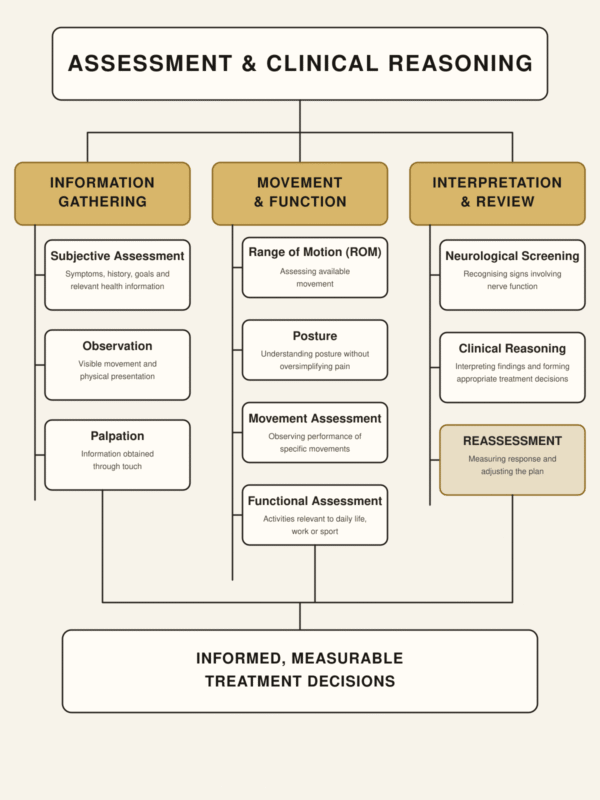

What You Need to Understand

Subjective Assessment — symptoms, history, goals and relevant health information
Observation — visible movement and physical presentation
Palpation — information obtained through touch
Range of Motion (ROM) — assessing available movement
Posture — understanding posture without oversimplifying its relationship with pain
Movement Assessment — observing how the body performs specific movements
Functional Assessment — examining activities relevant to daily life, work or sport
Neurological Screening — recognising signs involving nerve function
Clinical Reasoning — interpreting findings and forming appropriate treatment decisions
Reassessment — measuring response and adjusting the plan


Build Your Understanding

Assessment is not about finding one structure to blame. It is about gathering meaningful information and using it to make better clinical decisions.

Explore Assessment & Clinical Reasoning

Explore the articles below to develop a more systematic understanding of assessment and clinical reasoning.

Explore Assessment & Clinical Reasoning →