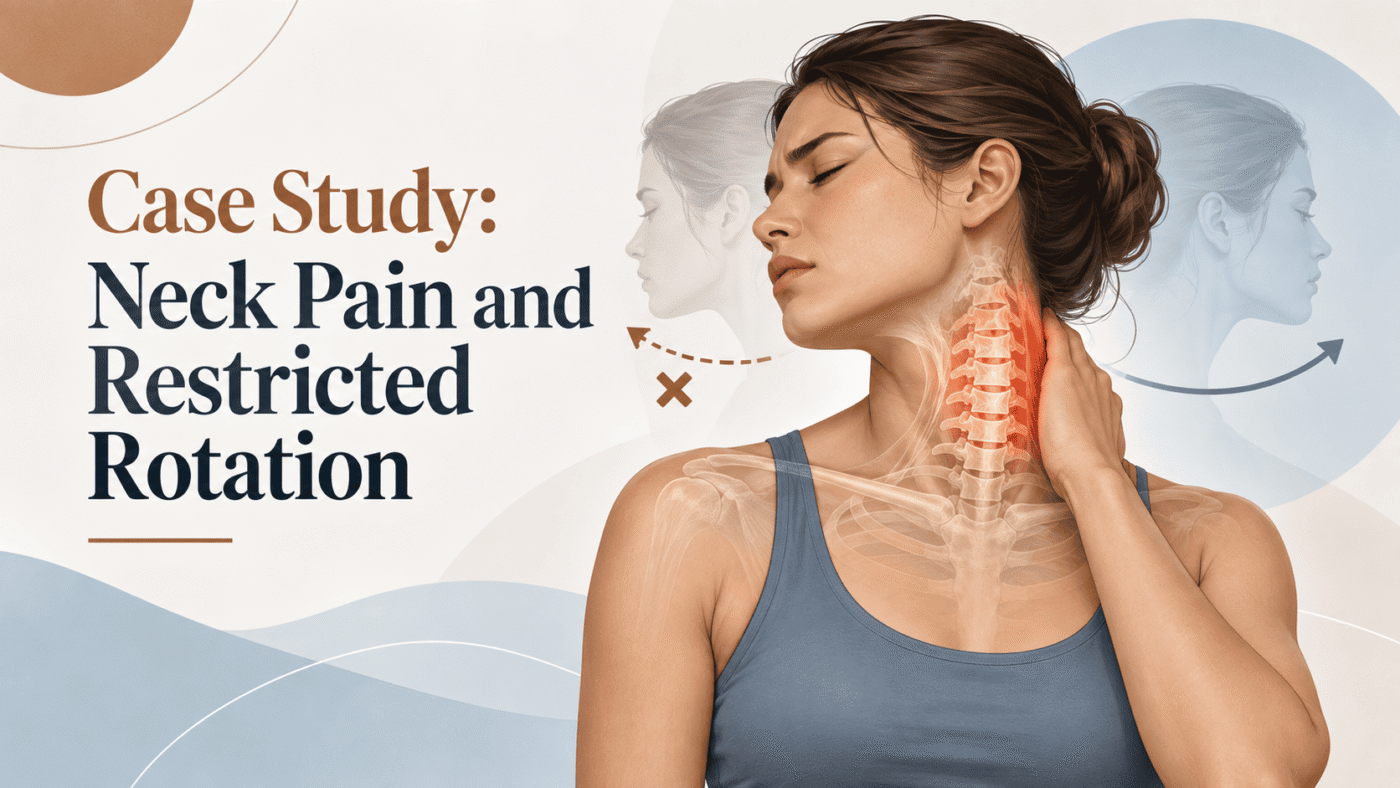
Neck Pain and Restricted Rotation
Case Study
A client walks into the clinic and says:
“My neck is tight and I can’t turn properly to the right.”
Sounds straightforward. Find the tight muscle. Massage it. Problem solved. Except… which muscle?
How do we know the problem is primarily muscular in the first place?
This case study looks at a common presentation neck pain with restricted rotation and shows how assessment, treatment and reassessment can help guide clinical decisions. This is an educational example rather than the story of a specific client. The important part isn’t the technique. It’s the reasoning.
Client Presentation
Imagine an office worker presents with:
- right-sided neck discomfort
- stiffness when turning the head to the right
- difficulty checking traffic while driving
- symptoms gradually developing over several days
- no specific traumatic event
The client describes the neck as: “Really tight.” They’ve already tried stretching. It feels temporarily better. Then the stiffness returns. Their main concern isn’t simply the pain. It’s this: “I can’t turn my head properly when I’m driving.” Now we have something useful to assess.
Screen Before You Treat
Most uncomplicated neck pain isn’t caused by a serious medical condition. But that doesn’t mean we skip screening. Symptoms such as significant trauma, progressive weakness, neurological changes, severe unusual headache, major balance or coordination problems, or feeling seriously unwell alongside neck stiffness may change what should happen next.
Sometimes treatment needs modification. Sometimes it needs postponing. Sometimes medical assessment is more appropriate. Knowing when not to treat is part of good treatment. In our example, imagine the history doesn’t identify any obvious warning signs requiring referral. Now we can continue the assessment.
Before touching the neck, we need more information. We might ask:
When did the symptoms begin?
Was there an injury?
Did they wake up with it?
Has this happened before?
Is the pain staying in the neck or travelling into the shoulder or arm?
Any numbness or tingling?
Any weakness?
Headache?
Dizziness?
Balance or coordination changes?
Recent illness or fever?
Any significant medical history?
Medication?
Previous neck injury or surgery?
What makes the symptoms better or worse?
This isn’t paperwork for the sake of paperwork. We’re trying to answer two questions: What might be relevant? and Is massage appropriate?
This is where the case becomes much clearer. The client says: “My neck hurts.” Pain matters. But we also have a functional problem: Difficulty turning the head to check traffic while driving. So rather than making the treatment goal: “Release the tight muscles.” we can define something more useful:
Reduce discomfort and improve comfortable right neck rotation enough to make checking traffic easier. Now we have something we can reassess.
Ask the client to comfortably rotate their head to each side. Don’t immediately force the movement. Observe.
How far can they turn?
Where does discomfort begin?
Does the movement feel stiff, painful or both?
Does one side differ noticeably from the other?
Is the client compensating by rotating the trunk?
Most importantly: Does this reproduce the problem they came in with?
Imagine: Left rotation feels comfortable. Right rotation is clearly more limited and produces the client’s familiar right-sided neck discomfort. Interesting.
But: Restricted rotation is a finding not a diagnosis.
We may estimate or measure cervical rotation to establish a baseline. Suppose right rotation is reduced compared with the left. That tells us:
Right rotation is currently limited. It doesn’t automatically tell us: Why.
Reduced range could relate to pain, sensitivity, muscle activity, joint-related factors, protective behaviour, previous injury or several factors working together.
So we don’t treat the ROM number as though it has already given us the diagnosis. Remember: Don’t treat the number treat the person.
Perhaps the client spends long periods working at a computer. Maybe their head appears slightly forward. Maybe one shoulder sits differently from the other. Useful observations.
But don’t jump to: “There’s your problem. Your posture caused your neck pain.” Posture can provide context. It doesn’t establish causation.
Instead, ask about:
Work duration.
Movement variety.
Breaks.
Exercise.
Recent workload.
Sleep.
Previous symptoms.
Activities outside work. Posture is information not a diagnosis.
*********
Palpation Adds Another Piece
Now we may palpate relevant areas. Perhaps certain muscles around the neck and upper shoulder feel tender. Maybe pressure over one area reproduces some of the client’s familiar discomfort.
That matters. But be careful. Palpation doesn’t give us X-ray vision. Feeling a firm or tender area doesn’t prove: “This is the exact tissue causing the problem.”
A useful distinction is: What I felt. Tenderness and a difference in tissue feel. What I think it might mean. This area may be relevant to the client’s symptoms. What I can demonstrate.
Pressure reproduces familiar discomfort and movement is currently restricted. Those are different levels of information. Interesting isn’t a diagnosis.
At this point, we have: A health history. No obvious red flags in this example. Right-sided neck discomfort. Restricted right rotation. A functional limitation when driving. Tenderness in relevant areas. Now we can form a working idea. Not: “I have discovered the root cause.”
More like: “This appears appropriate for a trial of conservative treatment, and we’ll see whether addressing relevant soft tissues and movement changes the client’s symptoms and rotation.”
That’s a hypothesis. And hypotheses are allowed to be wrong. In fact, good clinical reasoning requires that possibility.
Treatment may include appropriate manual therapy directed toward relevant areas based on the assessment. That might involve work around the neck, shoulder region and other areas considered relevant to the presentation. But the important question isn’t: “How many techniques can we fit into the session?” It’s: “What are we trying to change?”
Pressure should also have a reason. The client doesn’t need to survive an aggressive treatment to prove they’re committed to recovery. More pressure isn’t automatically better treatment.
Treatment should remain a conversation.
Comfort.
Response.
Symptoms.
Movement.
All provide information.
During treatment, we might find several sensitive areas. Very tempting.
Press all of them. But tenderness doesn’t automatically mean every area needs treatment. And finding more painful spots doesn’t necessarily mean we’ve discovered more problems.
Instead ask:
Does this finding relate to the client’s presentation?
Does treating it change anything meaningful?
That’s a much better filter.
This is the part that turns treatment into a clinical process rather than simply a collection of techniques. Ask the client to rotate their neck again. Same movement. Same direction. Same functional problem. Perhaps right rotation now feels easier.
Maybe the client can turn farther before discomfort begins. Maybe pain decreases. Maybe nothing changes. All three possibilities give us information.
The sequence is: Assess → Treat → Reassess
*********
Imagine the Movement Improves
Suppose the client can now comfortably rotate farther to the right. Excellent. We can reasonably say: The client’s right rotation improved immediately following this treatment session. Notice what we didn’t say:
“We corrected the joint.”
“We released the fascia.”
“We removed the trigger point causing the problem.”
“We fixed the root cause.”
The outcome tells us something changed. It doesn’t automatically prove the mechanism. That’s an important distinction.
Still useful information. Perhaps the client feels less discomfort but movement remains restricted. Now we know the response isn’t the same across every outcome. We may need to reconsider:
Does movement require more time?
Is another factor limiting rotation?
Would active movement help?
Is strength or control relevant?
Does the treatment plan need to change?
Again: Don’t force the result you expected. Observe the result you actually got.
This may be even more interesting. No change isn’t a failed assessment. No change is an outcome. If we expected a particular treatment to improve rotation and it didn’t, that should influence our next decision.
Maybe we modify the approach.
Maybe we investigate another movement.
Maybe the original hypothesis wasn’t very good.
Maybe manual therapy isn’t particularly useful for this presentation.
Maybe further assessment is needed.
Good clinical reasoning includes: Be willing to be wrong. Repeating exactly the same treatment indefinitely because: “Eventually this muscle will release” isn’t reassessment. It’s repetition.
Suppose rotation improves beautifully after treatment. The client is impressed. The therapist is impressed. Everyone goes home happy.
But what happens later?
That evening?
Tomorrow?
During work?
While driving?
Several days later?
Immediate change can be clinically useful. But it doesn’t tell us everything about longer-term recovery. That’s why we may ask the client to observe:
Does the improvement remain?
Does the stiffness return?
Can they drive more comfortably?
What activities provoke symptoms?
Does movement continue improving?
Do any new symptoms appear?
Treatment gives us information. Time gives us more.
*********
The Real Outcome Is Function
Remember why this client came in. Not because they wanted: “15 degrees more cervical rotation.” They wanted to check traffic more comfortably while driving.
So at follow-up, ask:
“How is driving?”
That question may be more meaningful than:
“Does your neck feel tight?”
We can still measure pain and ROM. But connect them to function. Measure what matters to your life.
If symptoms and function continue improving, the client may not need another treatment immediately. That’s okay. The purpose of treatment isn’t to create a weekly appointment forever.
If improvement is incomplete, we reassess.
If symptoms change significantly, we reassess.
If neurological symptoms develop, the decision may change entirely.
If treatment repeatedly produces only temporary relief without meaningful progress, we should reconsider the strategy rather than simply increasing the frequency or intensity.
A useful sequence is:
Treat → Observe → Reassess → Decide
Not:
Treat → Rebook → Repeat forever
From this hypothetical case, we might reasonably document:
Presentation
Right-sided neck pain with restricted right rotation.
Functional limitation
Difficulty checking traffic while driving.
Assessment finding
Right rotation reproduces familiar symptoms and is reduced relative to the opposite direction.
Treatment
Appropriate manual therapy based on the assessment and client tolerance.
Immediate outcome
Pain and/or right rotation changed after treatment.
Functional outcome
To be reassessed through the activity that matters to the client—driving.
Next decision
Based on symptom behaviour, function and response over time.
Notice what’s missing: A dramatic story about finding one hidden muscle responsible for everything.
We don’t need one.
*********
The Technique Wasn’t the Case Study
This is perhaps the most important lesson. A case study shouldn’t simply be:
“The client had neck pain. I used Technique X. The client felt better. Therefore Technique X fixes neck pain.” That tells us very little.
A more useful case study shows:
Presentation → Assessment → Reasoning → Treatment → Reassessment → Outcome → Reflection
That’s where the learning happens. Because another client can arrive tomorrow with: exactly the same complaint and require a completely different decision. Same symptom.
Different history.
Different findings.
Different person.
Different plan.
That’s clinical practice.
The Question That Keeps Us Grounded
Throughout this case, one question keeps returning: How do we know?
How do we know rotation is limited?
Assess it.
How do we know treatment changed it?
Reassess it.
How do we know the change matters?
Connect it to function.
How do we know the improvement lasted?
Observe it over time.
How do we know our explanation is correct?
We may not. So we remain willing to update it. That’s the difference between simply performing treatment and learning from treatment.
A useful framework is:
Listen → Assess → Form a Hypothesis → Treat → Reassess → Observe → Adapt
And perhaps the most important part is the last one.
Adapt.
Because the body doesn’t have to follow the treatment plan we wrote for it.
Your Body Talks. Learn to Listen.
And if your neck turns beautifully in the clinic but you still have to rotate your entire body to check the blind spot…we probably aren’t finished measuring yet.
Ask it. Even if you think it’s a ridiculous question.
Someone else has probably wondered exactly the same thing.
