
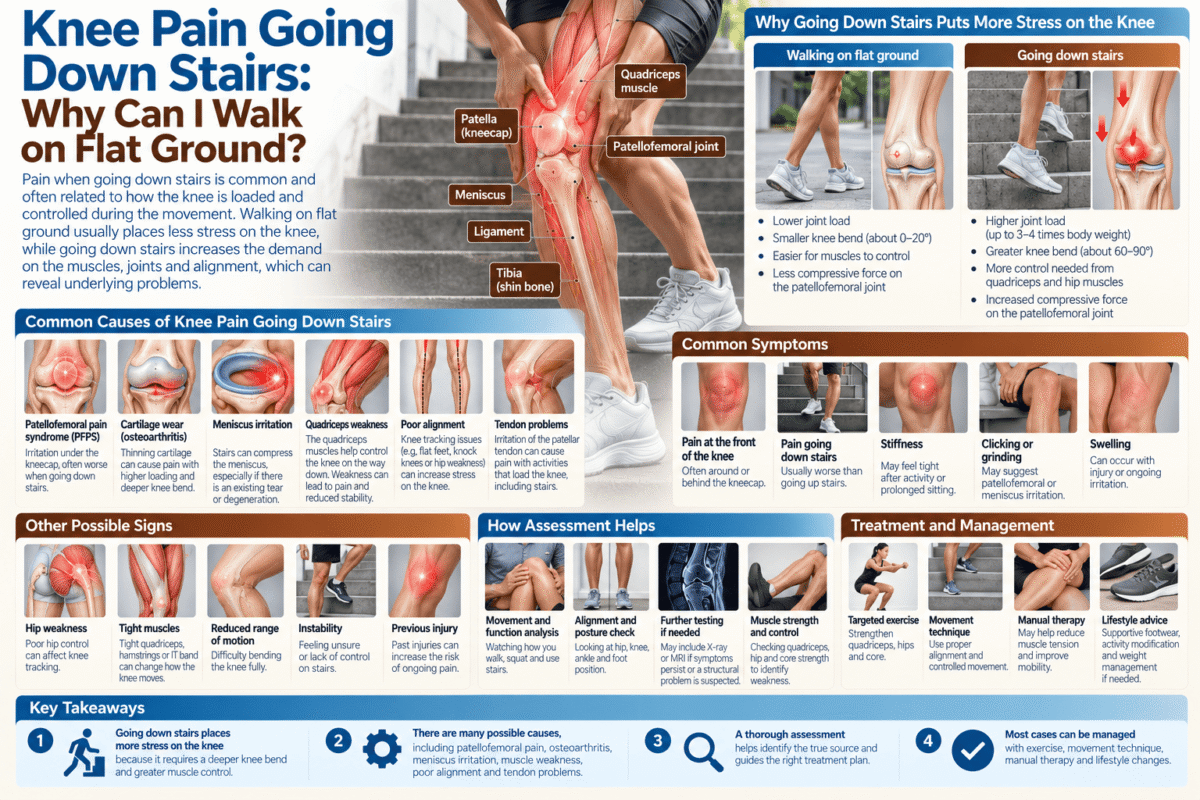
Knee Pain Going Down Stairs
Why Can I Walk on Flat Ground?
It is easy to assume something inside the knee must be damaged. Yet one painful movement does not identify a particular injury. Stairs ask your leg to support and control your weight while the knee bends. What matters first is where you feel the pain, when it started and whether the knee behaves differently during other activities.
“You walk across the room without thinking about your knee. Then you reach the stairs. Every step down hurts.”
Pain around or behind the kneecap can occur during stairs and squats, but several knee problems can make stairs uncomfortable. The pattern is a reason to assess, not a diagnosis you can make from the stairs alone.
What should you notice on the stairs?
Compare a few ordinary activities:
- Does it hurt going down, going up, or both?
- Is the pain in front of the knee, at the sides or behind it?
- Does a squat or getting up from a chair bring on a similar feeling?
- Did it begin after a fall, a twist or a change in your activity?
- Does the knee swell, lock, give way or stay painful after you stop?
Tell a clinician about the change that matters to you: “I can walk for 20 minutes, but I need the handrail to go downstairs.” That is more useful than a pain score on its own.
Does pain at the front of the knee mean it is the kneecap?
Pain around or behind the kneecap with stairs or squatting can fit a pattern called patellofemoral pain. However, the location does not confirm the condition. A clinician will consider your history, examine the knee and check whether another problem better explains the symptoms.
A new injury, marked swelling or a knee that cannot move normally changes that assessment. Avoid trying to force repeated stair tests to “find out” what is wrong.
Why might the assessment include my hip or ankle?
Going downstairs is a task for the whole leg. A clinician may watch how you step, check knee movement and strength, and look at the hip and ankle when relevant. This helps them understand which part of the task is difficult for you and choose a useful starting point for care.
You can read more about that connection in Anatomy and Pain: Why Does My Knee Hurt When You Check My Hip? The aim here is simpler: describe the stair problem clearly so it can be assessed.
What can help?
The plan depends on the cause and how irritable the knee is. It may involve temporarily adjusting an aggravating activity, then building movement and strength at a manageable level. For patellofemoral pain, exercise therapy is a central part of care; for knee osteoarthritis, guidelines also recommend exercise tailored to the person. Your clinician can help choose an approach when pain persists or the knee feels unstable.
A useful measure of progress is whether you can manage the stairs with more comfort and confidence over time, rather than whether one treatment made the knee feel different for an hour.
Can massage help?
Massage may help some people manage accompanying discomfort. Limited research in people with knee osteoarthritis suggests possible short-term symptom relief; those findings should not be treated as proof that massage resolves every kind of stair-related knee pain. Massage also cannot determine whether a painful knee has an injury that needs another form of care.
Tell your therapist if the knee is newly swollen, gives way, or became painful after an injury before any hands-on treatment begins.
When should you seek prompt medical help?
Get urgent assessment if your knee is red and swollen and you have a fever, or if you cannot bear weight on it. A visibly deformed knee after an injury also needs urgent care. These are situations to assess medically rather than trying to massage or exercise through the pain.
From a therapist: “Show me the step that hurts. Then tell me what changed before it started. That gives us a better starting point than guessing what is wrong inside the knee.”
Your Body Talks. Learn to Listen.
Being able to walk on flat ground does not make stair pain imaginary or identify its cause. Notice the movement, the location and any swelling or instability. Use those observations to guide assessment and a plan you can measure against the stairs that matter to you.

Ask it. Even if you think it’s a ridiculous question.
Someone else has probably wondered exactly the same thing.
