
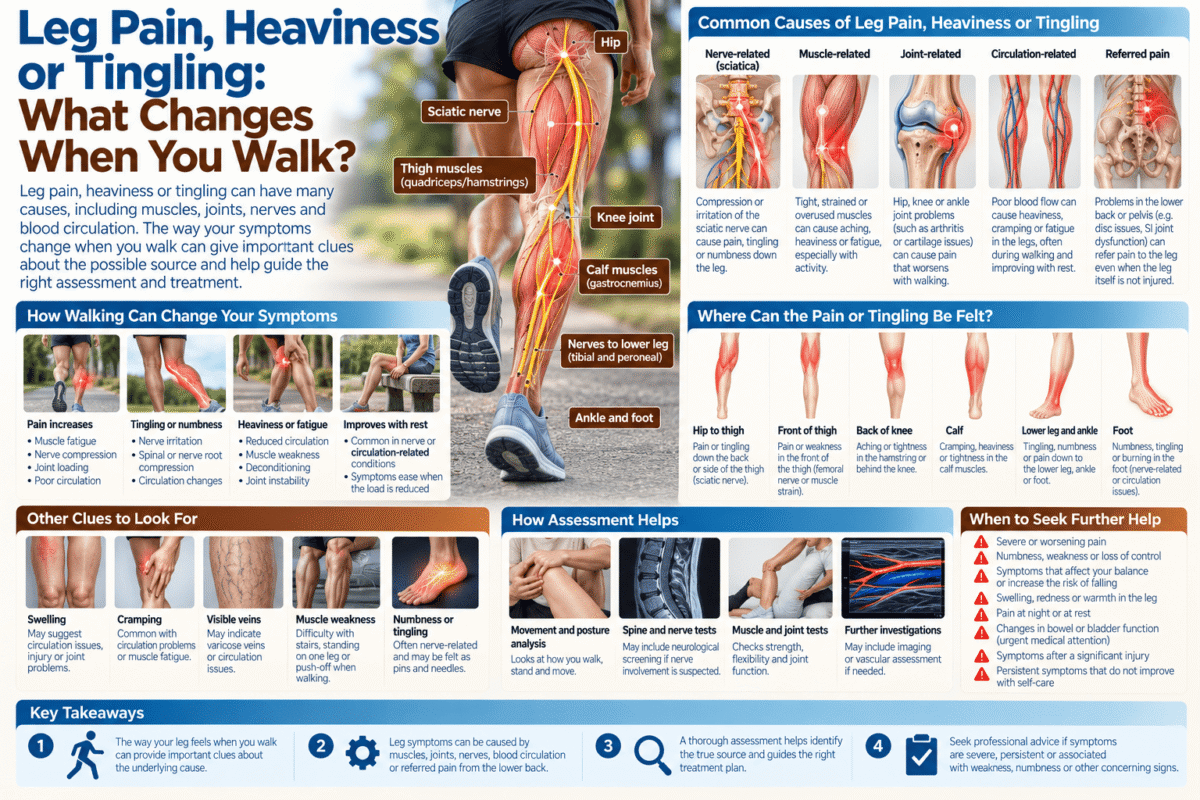
Leg Pain, Heaviness or Tingling
What Changes When You Walk?
Do you need to stretch your calf? Could the problem be in your back? The answer depends on what happens before, during and after the symptom appears.
“You set out for a walk. After a few minutes, one leg begins to feel heavy. Soon, you notice an ache or tingling.”
Leg pain can involve muscles, joints, nerves or circulation. The feeling alone cannot identify its cause. However, its pattern can help you decide what to tell a clinician and whether massage is an appropriate next step.
What should you notice first?
Think about a recent walk and ask:
- Where did it begin? In the back, buttock, thigh, calf or foot?
- What did you feel? An ache, cramp, heaviness, tingling, numbness or loss of strength?
- When did it start? With your first steps, after a predictable distance, or only later?
- What helped? Stopping to rest, sitting down, changing position or ending the activity?
- What else changed? Did the leg swell, become unusually cold, or make you trip?
You do not need to turn these answers into a diagnosis. Their value is that they make the next assessment more precise.
Could the pain come from my back?
It can. Some back related nerve problems cause pain that travels through the buttock and down a leg. Tingling, numbness or weakness may occur as well. Still, pain running down the leg does not automatically mean you have sciatica; an examination and your full history matter.
Tell your clinician if bending, sitting or changing position affects the symptoms. Also mention any new weakness, such as a foot that catches the floor when you walk.
What if it appears after walking a similar distance?
Leg pain or cramping that repeatedly begins with walking and settles after a few minutes of rest can sometimes be related to reduced blood flow to the leg muscles. That pattern deserves medical assessment, particularly if it keeps happening. It should not be assumed to be a tight calf that needs deeper massage.
A recent increase in exercise can also be relevant. Rather than guessing from one episode, note how far you walk before symptoms begin and how quickly they settle.
What are the options for care?
Treatment depends on the cause. Following an injury, an assessment may focus on the affected muscle or joint and help you return to activity gradually. For nerve symptoms, a clinician may assess strength, sensation and the back as well as the leg. A walking related circulation problem calls for medical evaluation and a different care plan.
A practical goal might be: “I want to walk to the shops without my leg giving way.” That gives you a way to judge whether care is improving something meaningful.
Can massage help?
Massage may provide comfort for some muscle related discomfort. It cannot tell you whether leg pain is caused by a nerve or a circulation problem, and it is not a treatment for a suspected blood clot. Evidence for massage in related pain conditions is mixed or limited, so it should be considered according to the assessment rather than offered as the answer to every painful leg.
Tell your therapist about new swelling, unusual warmth, numbness or weakness before the session begins.
When should you seek urgent help?
Seek urgent medical assessment for new pain and swelling in one leg, especially around the calf, because a blood clot is one possible cause. If you also have chest pain or trouble breathing, call your local emergency number.
Call for emergency help if a leg or foot suddenly becomes cold, pale or numb, or if you suddenly cannot move it. New leg weakness or numbness with a change in bladder or bowel control also needs emergency assessment.
From a therapist: “Tell me how far you can walk before the symptom starts, and what happens when you stop. That may be more useful than pointing to the sorest spot.”
Your Body Talks. Learn to Listen.
The timing of leg symptoms matters. Notice what walking brings on, what rest or a change of position does, and whether swelling, numbness or weakness is present. Those details help direct you towards the right assessment and care.

Ask it. Even if you think it’s a ridiculous question.
Someone else has probably wondered exactly the same thing.
