
Flexibility
Why Do I Still Feel Tight After Stretching?
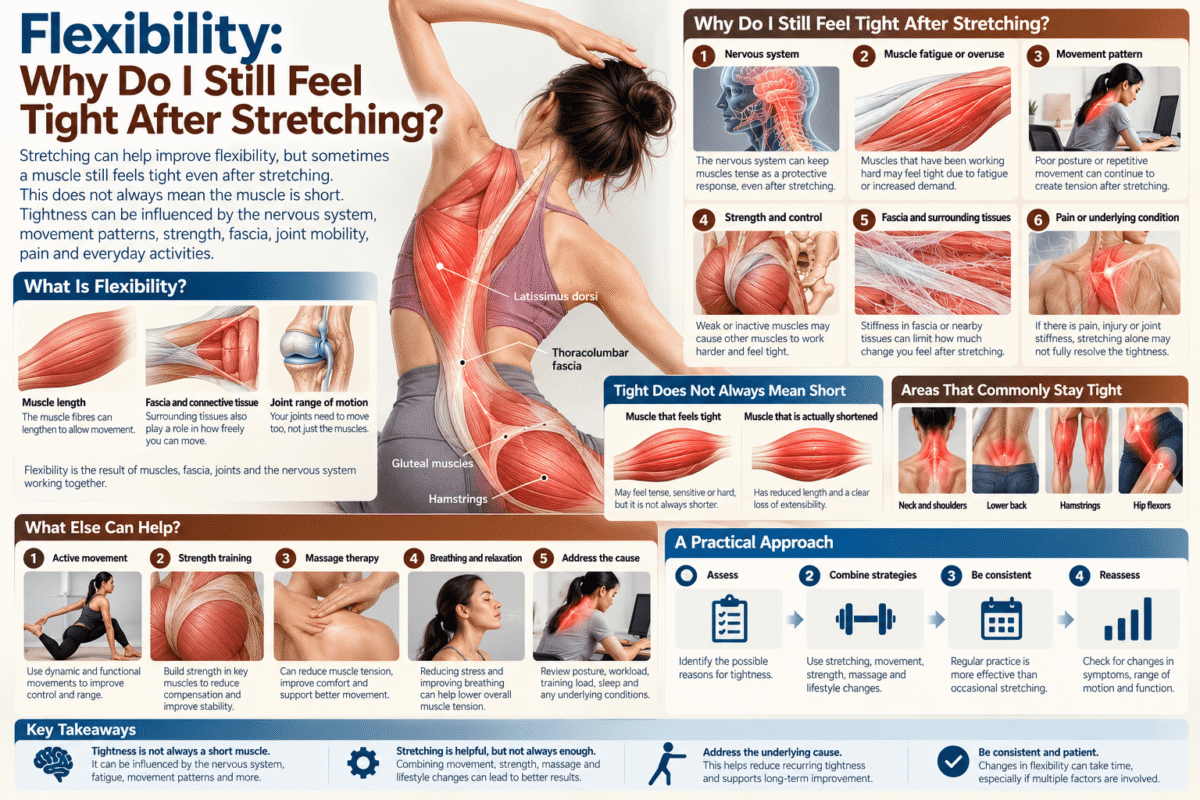
It is tempting to stretch harder or book a deeper massage. Before you do, ask a more useful question: What are you trying to improve the feeling of tightness, the movement itself, or your ability to use that movement?
“You stretch after every workout. Your legs feel looser. Then, by the next day, they feel tight again.”
Flexibility describes how far a joint can move in a particular direction. For example, you might notice it when reaching towards your toes or turning your head. Yet reaching farther does not automatically mean a specific muscle was previously “too short.”
Research shows that regular stretching can improve range of motion. Changes in how a stretch feels may be part of that improvement, alongside changes in the muscle and tendon tissues.
Why might tightness keep returning?
A feeling of tightness is worth listening to, but it cannot identify its own cause. Think about when it appears:
- Only after a hard workout? Your recent training may be relevant.
- When you first start moving, then it eases? Compare how you feel before and after a gentle warm-up.
- Every time you try one specific movement? Notice whether the movement feels limited, painful or difficult to control.
- Along with tingling, numbness or weakness? Seek a clinical assessment rather than assuming you need a stronger stretch.
These observations give your therapist or clinician more to work with than “my hamstrings are always tight.”
Should you stretch more?
Stretching can be useful if your goal is to improve a specific range of motion. Choose a movement you can repeat and track whether it becomes easier over time. There is no need to judge progress by how intensely a stretch hurts.
Strength work may also improve range of motion. In a review comparing the two approaches, strength training and stretching showed similar effects overall, although the studies varied considerably. Therefore, if you can reach a position but struggle to control it, practicing movement and strength through a comfortable range may be more useful than adding another stretch.
Can massage improve flexibility?
Massage may help you feel more comfortable or make movement feel easier for a while. That can create an opportunity to practice the movement you want to regain. However, a session should not be described as permanently “lengthening” a muscle, and massage alone is unlikely to answer why tightness repeatedly returns. Evidence for massage benefits varies by condition and is often limited to short-term outcomes.
Tell your therapist what you want to do squat, run, lift your arm or sit comfortably so you can assess progress against a real activity.
What should you do next?
Pick one movement that matters to you. Notice how far you can move, whether it hurts, and whether you can control the position. Then try a manageable combination of movement practice, stretching or strength work suited to your goal. If symptoms persist, worsen or follow an injury, seek an individual assessment.
From a therapist: “Feeling looser after treatment is useful feedback. Being able to move comfortably and use that movement in daily life tells us more.”
Your Body Talks. Learn to Listen.
Flexibility is one part of movement. If tightness keeps returning, look beyond how hard you stretch and consider what your body can move through, control and tolerate.

Ask it. Even if you think it’s a ridiculous question.
Someone else has probably wondered exactly the same thing.
