
Movement & Mobility

Understanding Movement

Human movement depends on more than flexibility.
Movement requires the coordinated interaction of mobility, strength, motor control, balance and the nervous system.

Having greater range of motion does not automatically mean that movement is better, just as stiffness does not always mean that a structure needs to be stretched.

Mobility, Control & Capacity

Mobility describes the ability to move through an available range, while strength and motor control help the body manage that range.

A useful movement strategy therefore requires both freedom of movement and the capacity to control it.

Physical demands also differ between individuals. The movement required by an office worker may be very different from that required by a runner, tradesperson or competitive athlete.
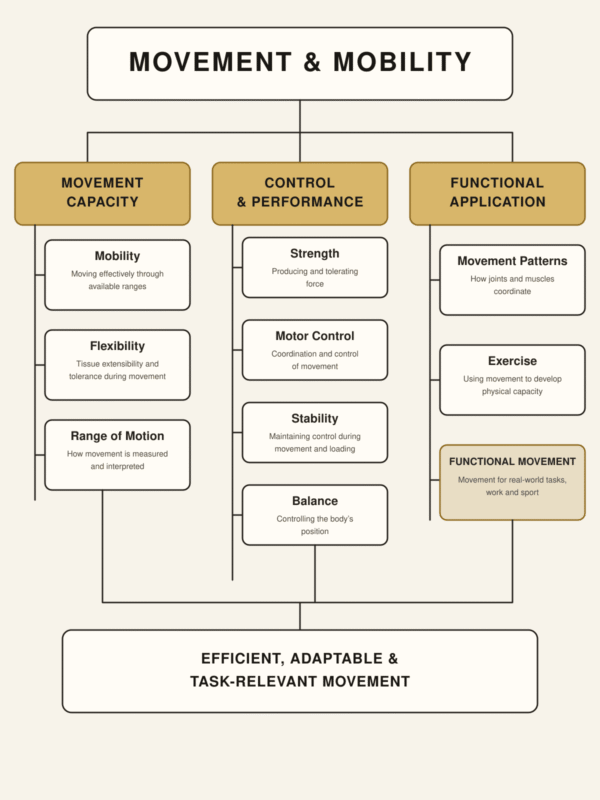

What You Need to Understand

Mobility — the ability to move effectively through available ranges
Flexibility — the extensibility and tolerance of tissues during movement
Range of Motion — how movement is measured and interpreted
Strength — the ability to produce and tolerate force
Motor Control — coordination and control of movement
Stability — maintaining control during movement and loading
Balance — controlling the body’s position
Movement Patterns — how multiple joints and muscles coordinate
Exercise — using movement to develop physical capacity
Functional Movement — movement in relation to real-world tasks, work and sport


Build Your Understanding

The goal is not simply to become more flexible. It is to develop movement that is appropriate, controlled and capable of meeting physical demands.

Explore Movement & Mobility

Explore the articles below to understand mobility, strength and movement in greater depth.

Explore Movement & Mobility →